

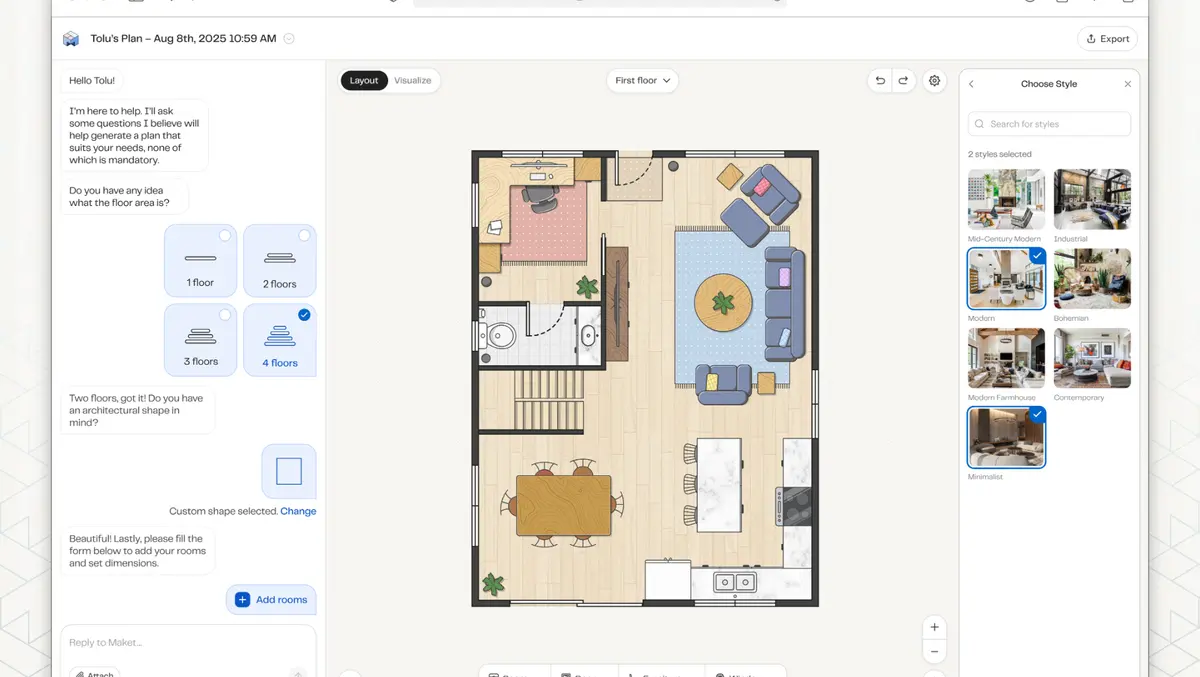

Maket has launched Version 2 of its home design platform, expanding its use of conversational artificial intelligence in residential planning.
The Montreal-based company says the new version lets users create floor plans, alter layouts and visualise spaces within a single product. It is aimed at homeowners, renovators and others who want to describe a design in plain language, then adjust it on screen or through text prompts.
The release marks the next stage for the startup, which says it has surpassed 1 million registered users and raised CAD $3.7 million in seed funding. Version 2 is available immediately, with pricing starting at $20 a month for individual users.
Three functions
The platform combines three main functions. The first is floor plan generation, where users describe what they want and the system produces a plan. The second is floor plan editing, including a drag-and-drop editor for moving walls, resizing rooms and changing layouts.
The third focuses on visualisation, allowing users to see spaces in different styles, furniture arrangements and materials. A prompt-based editing feature is also due shortly, enabling users to request changes such as a larger kitchen or an additional bedroom and have the software apply them automatically.
The product is aimed at consumers who may not have the budget or technical background for traditional design processes. Maket also offers products for business customers, including builders, prefab manufacturers and developers, with tools that can integrate plan libraries and workflows into the platform.
That combination reflects a broader push across property and design technology to use generative AI for more practical tasks than image creation alone. Here, the focus is on moving from idea generation to structured planning and revision for real-world spaces.
Patrick Murphy, co-founder and chief executive officer of Maket, said the launch is centred on ease of use for non-specialists.
"Designing your own home shouldn't be hard, but for most people it has been," said Patrick Murphy, Co-Founder and Chief Executive Officer, Maket. "Our mission has always been to democratize architectural design, and V2 is the fullest expression of that. You can go from idea to finished floor plan through simple conversation, edit visually or just tell the AI what you want, and see your space before it's built. Everything you need is in one place, and none of it requires any design experience."
Consumer focus
Maket's messaging places homeowners and small-scale property projects at the centre of the launch. The company points to use cases including house renovations, garage conversions, basement projects and backyard developments, all of which often fall below the threshold at which many consumers would hire an architect from the outset.
That positions Maket between professional architectural software and consumer inspiration tools. Traditional design software often requires training, while mood boards and image-led tools can help users picture a result without producing a usable floor plan.
By combining text input, on-screen editing and visual review, Maket is targeting users who want a design process with fewer specialist barriers. It argues this could help them move from an early concept to a more defined plan without manual drafting.
The launch also shows how startups are trying to apply generative AI to tightly defined workflows rather than broad creative tasks. For Maket, the challenge will be whether those workflows can reliably meet the expectations attached to home design, where room sizes, circulation, layout constraints and build feasibility matter more than novelty.
Maket was founded by Patrick Murphy, Stéphane Turbide and Simon Vallee. It says it has a team of 17 based in Montreal.
For now, Maket is using a subscription model for individuals while keeping a separate route for larger industry customers. That dual structure suggests it is seeking to capture consumer demand while also testing whether housebuilders and developers will use the same system in more formal planning and design settings.
Version 2 follows an earlier preview of the product's direction after the company announced its seed round. That release has now arrived with floor plan generation, editing and visualisation brought together in one platform, with entry pricing set at $20 a month.