

OpenAI launches GPT-Live for ChatGPT Voice globally
Thu, 9th Jul 2026 (Today)
OpenAI has launched GPT-Live, a new voice model for ChatGPT Voice, and is rolling it out globally to ChatGPT users.
The release changes how ChatGPT handles spoken conversations. GPT-Live uses a full-duplex design that lets it listen and speak at the same time, instead of waiting for one speaker to stop before the other responds.
That is intended to make exchanges sound less rigid than earlier voice systems. The model can acknowledge a speaker with short interjections, pause while a user thinks, and continue a conversation while other tasks are handled in the background.
OpenAI is introducing two versions: GPT-Live-1 and GPT-Live-1 mini. GPT-Live-1 will become the default model for ChatGPT Voice for Go, Plus, and Pro users, while GPT-Live-1 mini will be the default for free users.
GPT-Live can hand off more demanding work to another model when a conversation requires web search, more complex reasoning, or other multi-step tasks. At launch, that background model is GPT-5.5, allowing the voice system to keep the conversation going while a separate model completes the request.
How it works
The architecture differs from earlier generations of voice tools used in ChatGPT. Older systems relied on a chain of separate models for speech recognition, text generation, and speech synthesis. Later turn-based versions used one model for audio but still waited for clear pauses before responding.
Those approaches could produce delays, awkward interruptions, and a more mechanical rhythm. By processing incoming and outgoing audio continuously, GPT-Live can make decisions several times a second about whether to speak, keep listening, pause, interrupt, or call another tool.
This also improves the system's ability to maintain the flow of conversation during longer exchanges. OpenAI added that the model can perform live translation and maintain stronger timing than previous versions.
OpenAI is also updating the front-end ChatGPT Voice experience around the new model. Users will be able to choose between different levels of reasoning for replies, ranging from faster responses to modes where the system spends longer working through a question.
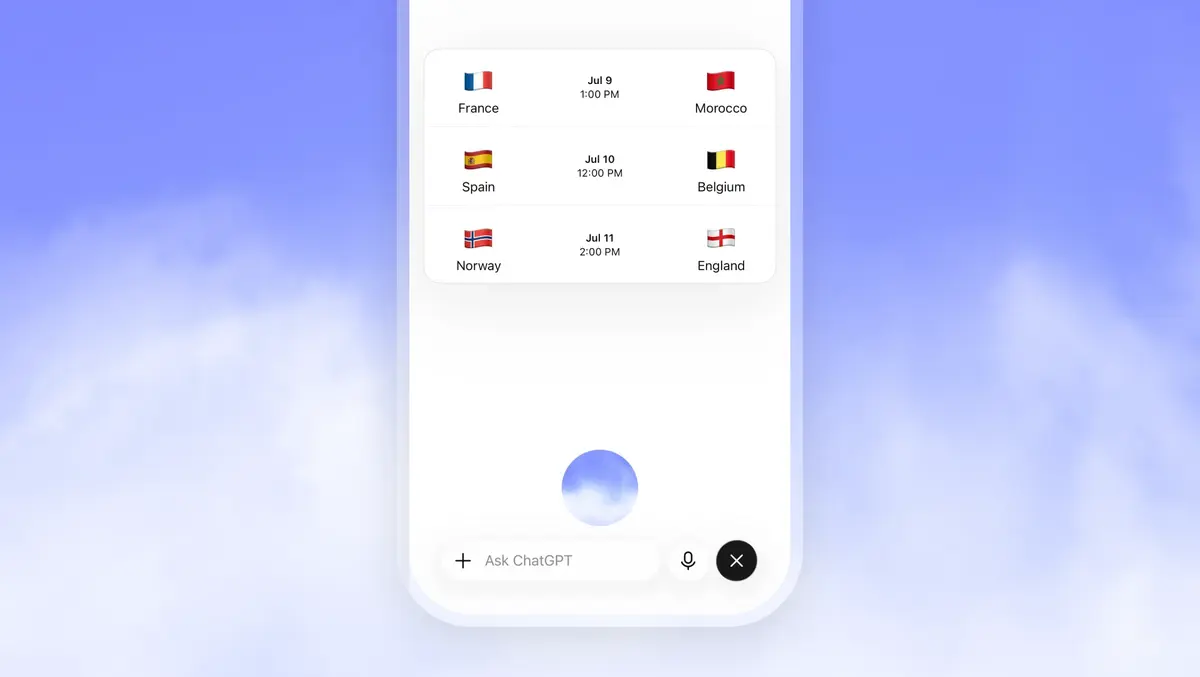
Some responses will now appear as visual cards during a spoken exchange. These can cover subjects such as weather, shares, and sport, while voice conversations will continue to support search, memory, images, and file uploads.
Usage scale
More than 150 million people use ChatGPT voice and dictation features each week, according to OpenAI. The company said those tools are used for everyday assistance, language practice, storytelling, and informal conversation.
OpenAI has also remastered the nine voices available in ChatGPT for use with GPT-Live. The model has been tuned to listen more effectively when there is background noise and to avoid interrupting when a speaker pauses briefly.
Not all features available in older versions of ChatGPT Voice are included in the new release. At launch, GPT-Live does not support voice with video or screen sharing in ChatGPT, though legacy voice modes remain available where those features are supported.
OpenAI said it has optimised the new model for some of the most widely used languages in ChatGPT. It added that certain languages may still produce a non-native accent or gaps in fluency.
Testing and safety
OpenAI said it created new human assessments to compare conversational flow and overall user preference between GPT-Live and Advanced Voice Mode. In matched conversations lasting between five and 10 minutes, GPT-Live-1 and GPT-Live-1 mini were preferred over the earlier system on measures including turn-taking, interruptions, and how natural the interaction felt.
It also reported gains on several benchmark tests. According to OpenAI, GPT-Live-1 outperformed Advanced Voice Mode on GPQA, which measures scientific reasoning; BrowseComp, which tests web search for difficult-to-find information; and an internal telecom support benchmark built around multi-turn voice tasks.
Safety has been a central part of the launch, particularly because spoken exchanges happen in real time and can involve emotionally sensitive situations. OpenAI said it expanded testing with audio-focused evaluations and synthetic tests covering self-harm, psychosis and mania, emotional reliance on AI, violence, and sexual content.
Internal experts also red-teamed the model for risks specific to voice. OpenAI said GPT-Live performed comparably to or better than Advanced Voice Mode across nearly all the areas it assessed.
Built-in safeguards can intervene while the model is speaking. The system can steer a response in a safer direction, present extra safety messaging or resources, or end a conversation in higher-risk cases.
OpenAI said it has adapted ChatGPT support flows for voice in conversations involving self-harm, including offering crisis helpline support. It also added protections for teenage users, including age-appropriate behaviour in the model, parental controls over voice access, and possible notifications to linked parents in higher-risk situations involving signs of potential self-harm or suicidal intent.
OpenAI said GPT-Live is designed for conversation rather than voice impersonation and uses a fixed set of predefined voices with safeguards intended to prevent the imitation of a real person's voice.
The rollout covers iOS, Android, and ChatGPT on the web, with API access expected to follow.