

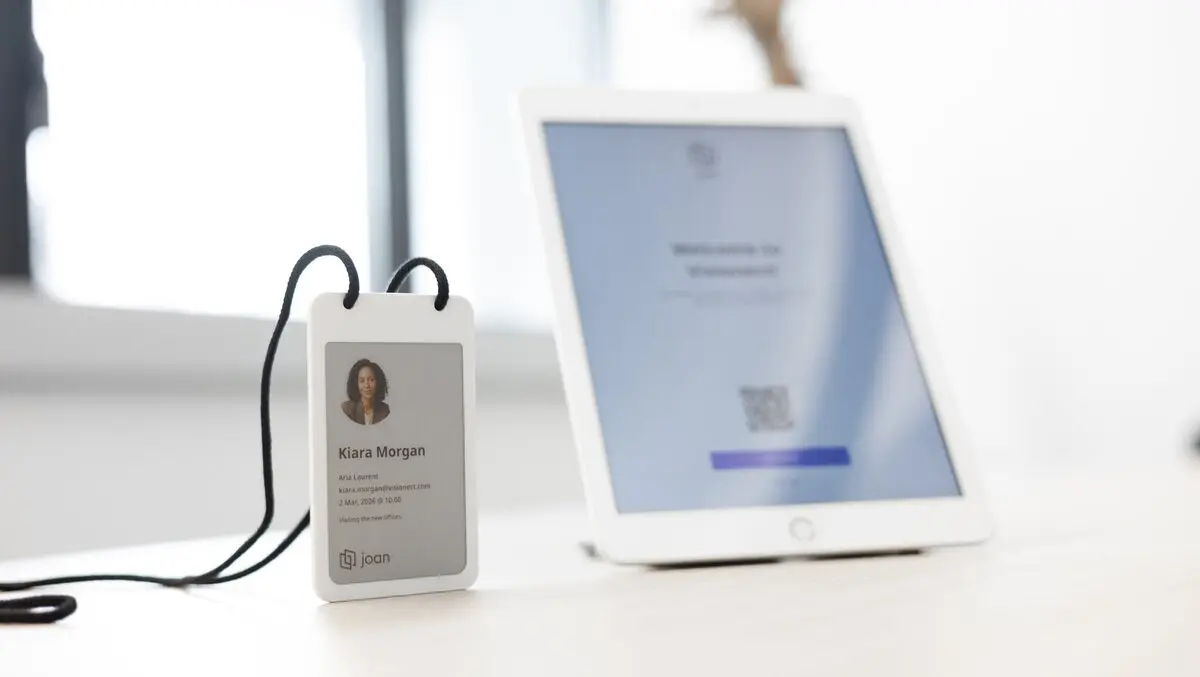
Joan launches reusable ePaper badge in US & Canada
Thu, 29th Oct 2026 (Today)
Joan has launched its reusable ePaper badge in the United States and Canada, extending its badge system beyond visitor check-in to employee identification and event use.
Managed through the Joan Workplace platform, the badge can be updated wirelessly over Bluetooth instead of being reprinted. A single badge can be configured for one role at a time, allowing organisations to use the same hardware for staff IDs, visitor passes and event registration.
The launch expands a product that began as part of Joan's visitor management tools. The badge is now available in more than 90 countries, including the US and Canada.
Managed identity
Joan is positioning the badge as a managed endpoint within workplace and security systems rather than a standalone printed credential. It works on the same platform as the company's meeting room displays, desk booking, visitor management and digital signage tools, allowing administrators to push updates centrally and revoke badges when needed.
The approach addresses a common problem for IT and facilities teams: printed cards and labels can remain in circulation after a role change or departure. Changes to a person's title, photo or access rights can be sent to the badge when it comes within Bluetooth range.
For employee use, badges are set up in batches through the Joan Mobile App. If a badge is reported lost, access can be cut off immediately through the linked access-control system, while the screen updates the next time the device is nearby.
Each badge also includes an NFC chip, allowing it to be used for door access where building systems support that function. That means the same badge can serve as both visible identification and an access credential.
The rechargeable battery lasts about 200 days on a charge, according to Joan. Users can also cycle through different information screens using a button on the back of the badge.
Event use
Joan is also targeting event organisers, who often rely on printed badges that must be replaced when registration details change. Event badges can be written directly from attendee lists, updated for walk-ins and amended through a re-sync rather than a full reprint.
The device can display more than a name, including a person's company, role or session access, based on registration data. Joan said this flexibility makes it suitable for uses ranging from corporate conferences to trade show booths.
Visitor management remains the badge's original use case. A guest checking in at reception can be assigned a badge automatically if a device is within Bluetooth range, with the screen showing details such as name, company, photo and host.
Once the visit ends, the badge is returned to a dock and cleared for reuse. The system can also flag cases where a visitor keeps a badge beyond their expected time on site.
Broader platform
The badge sits within a wider ePaper product line that began with wireless meeting room displays. Joan now serves around 5,000 customers in more than 100 countries and has shipped roughly 100,000 ePaper devices.
Its business has shifted increasingly towards software as the platform has expanded across workplace management functions. The badge reflects that strategy by bringing another physical object into the same management system used for room, desk and visitor tools.
Design remains a notable part of the brand's positioning. Joan said its products received more than a dozen design awards in 2026, including Red Dot and German Design Awards.
In a statement, Luka Birsa, Co-founder and CTO at Visionect, said the badge reflects the company's longer-term view of digital identity and display technology.
"We've spent nearly two decades on one belief: a display should only change when something real changes, and otherwise disappear into the background. A badge is that idea distilled to its smallest, most personal form: a name, a photo, a set of permissions, updated the moment it needs to be and invisible the rest of the time. A visitor wears one for an afternoon. An employee wears one for years. A conference badges a few thousand people in a weekend. Different lifespans, same object, same principle: identity that keeps pace with the person carrying it, without anyone having to think about it. That's not a small idea. It's the one we started the company on, and it's still the one we're building toward," Birsa said.